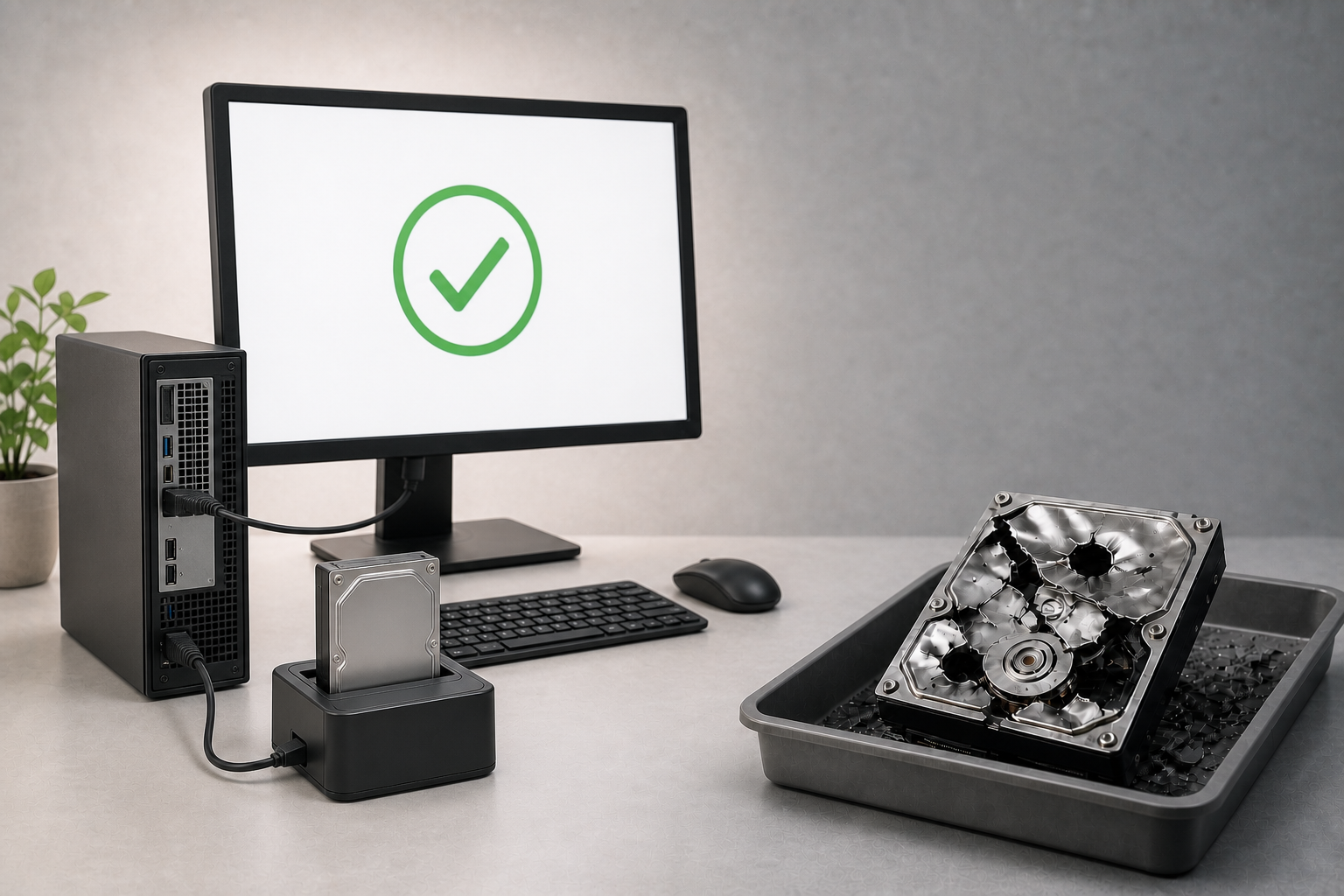
When you’re responsible for IT asset disposition, you face a crucial decision: should you physically shred hard drives, or securely wipe them? The right answer isn’t just about ticking a compliance box, it impacts data security, environmental footprint, and your bottom line. From years on the job, I’ve seen both approaches up close. Here’s why secure drive wiping usually comes out ahead.
Data Security: Wiping Leaves No Trace
It’s a common myth that only shredding makes data unrecoverable. In reality, modern data erasure tools; if properly configured, make the data on a drive permanently inaccessible. Certified software like Blancco or Certus overwrite every sector, often multiple times, following standards like HMG Infosec or NIST 800-88. Drives wiped this way pass forensic audits; even with sophisticated lab tools, data can’t be reconstructed from the platters.
Shredding, on the other hand, isn’t always foolproof. Many shredders produce chunks large enough that, with enough time, data fragments could theoretically be pieced back. I’ve seen drives shredded at 40mm and 25mm-only the latter is considered compliant for classified data, and even then, the process can miss small SSDs or leave chips intact. With erasure, you get a digitally verifiable certificate for every drive, not just a bin of metal shards.
Environmental Impact: Wiping Enables Reuse
Shredding is final-whatever’s destroyed is headed for recycling, at best. But recycling isn’t a silver bullet: separating mixed metals, plastics, and rare earths from shredded e-waste is energy-intensive and far from 100% efficient. The UK produces over 500,000 tonnes of e-waste a year; most isn’t recycled at all.
Wiping hard drives, though, means the device can be re-used, resold, or donated. At Retsu, about 65% of drives we process are suitable for reuse after secure erasure and testing. That’s hundreds of kilos of material kept in circulation each month, extending device lifespans by 3-5 years and massively reducing the embedded carbon of IT operations. For most clients, that’s a sustainability win they can report on-something you don’t get from a skip full of shredded metal.
Cost and Logistics: Wiping is Often Cheaper
Physical shredding isn’t just a matter of feeding drives into a machine. Mobile shredding trucks are expensive to run and maintain. Offsite shredding means paying for secure transport-plus you lose any residual value in the hardware. As of 2024, shredding a batch of 100 drives can cost between £500-£800, depending on location and transport needs. You’ll also have to pay for hazardous waste disposal, especially with enterprise SSDs containing rare metals.
Secure erasure, by contrast, can be handled in-house or by a certified partner, often with lower direct costs. The real kicker: wiped drives can be resold. We routinely see enterprise SATA drives wiped, tested, and resold for £10-£40 apiece, depending on capacity and health. That can offset or even exceed the cost of erasure, turning a compliance process into a small revenue stream.
Compliance and Audit Trail
Regulations like GDPR, WEEE and the UK Data Protection Act demand not just data destruction, but a verifiable record. With shredding, proof is a generic destruction certificate-no serials, no audit trail. Secure wiping software logs drive serial numbers, erasure method, operator, and timestamp. At Retsu, we integrate this data directly into our asset management system, so clients have a full chain of custody for every drive. Come audit time, that’s the difference between a tick and an awkward conversation.
Shredding may still be required for some government or defence data, but for most commercial environments, a documented erasure process meets (and often exceeds) legal and client expectations.
When Shredding Makes Sense
There are exceptions. Drives that fail erasure, are physically damaged, or are so old that their firmware can’t be reliably wiped still need to be destroyed. Likewise, classified government contracts may specify shredding to a certain particle size. But for the bulk of business drives, wiping is faster, greener, and more transparent.
Practical Takeaways
Secure wiping gives you control, compliance, and sustainability-all with a clear audit trail. While shredding still has a place, it’s no longer the default for secure IT asset disposition. My advice? Invest in certified erasure tools, keep your process transparent, and only shred when there’s no alternative. Your data, your budget, and the planet will all thank you.